
Somewhere In-Between
Three weeks into training and homestay life are filled with many highs (and a few lows)

A small housekeeping note: I didn’t know this thing had a button to pay to subscribe, and frankly, I have no idea how to disable it now. For those of you that did pay to subscribe, that’s incredibly sweet of you (and for those that didn’t, it’s not necessary whatsoever!). All the subscriptions I receive will go towards my work here. Most Peace Corps volunteers complete a special community project in their second year of service. This can be anything the school/community needs, and many English teachers decide to build a school library. The important thing is this project is led by the community — not by me — so I have no idea what that will be yet! But whatever form it takes, those funds will go towards that.
“You’re going to have to write about this,” my fellow volunteer Kailyn told me as we finished wrangling the barbed wire out from my bike chain on our ride home from training.
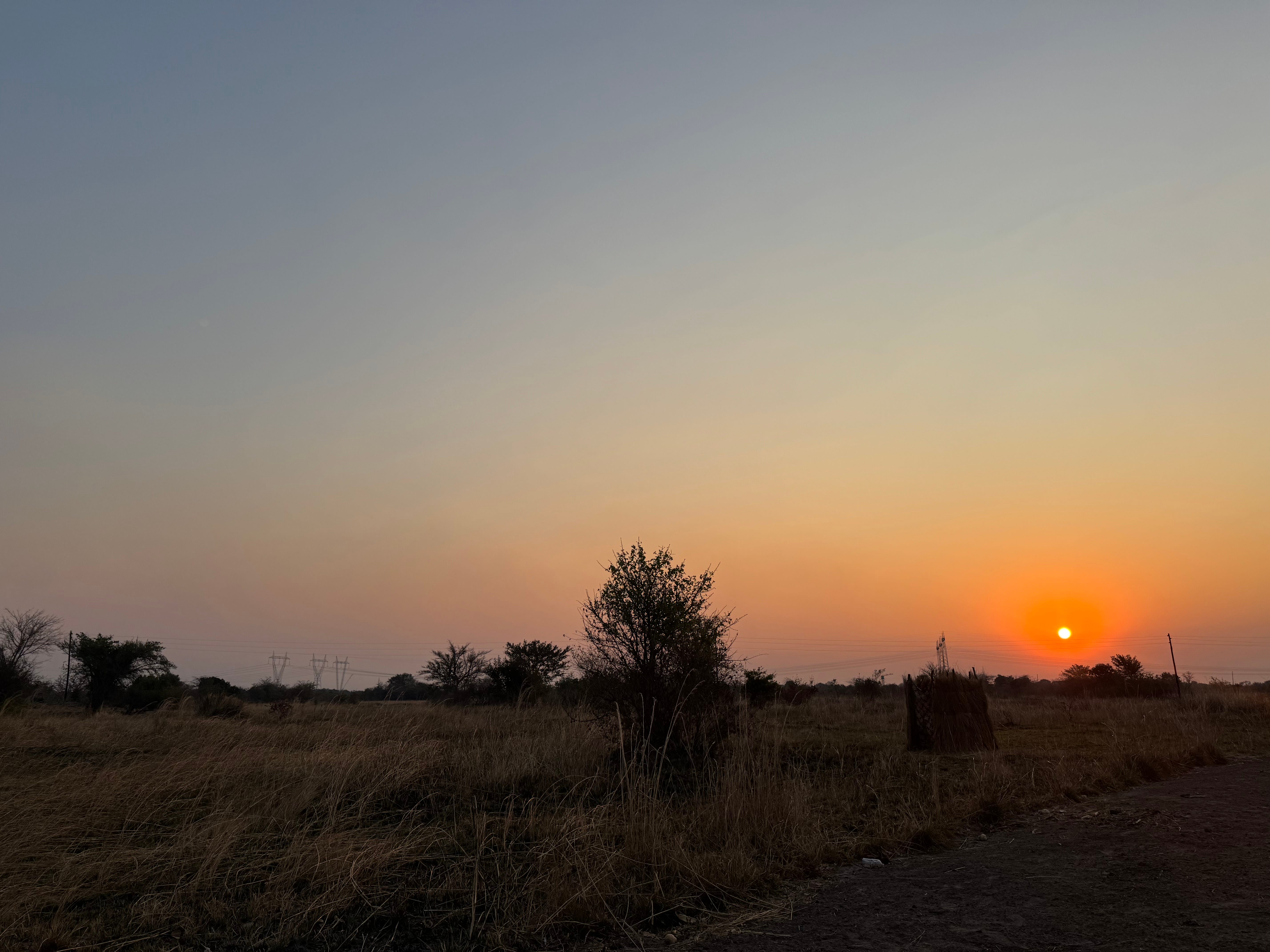
It wasn’t the first major bike issue I’d had that week and it wouldn't be the last. I’d battled comically flat tires, tires straight up falling off the frame, and now the barbed wire. But this time, I had a legitimate excuse: the sunset was behind me, I of course had to turn around to see it, and then boom, I didn’t see the barbed wire in the middle of the path.
But I couldn’t miss the opportunity for a Zambian sunset. The sun is unbelievably big, unbelievably red. The pinks and reds and purples linger in the sky. There are worse places to get in bike accidents.
But besides the bike lows (including one genuinely terrifying incident this week of getting chased by dogs while on the bike), I really only dwell on the many, many highs here in Zambia. From our first day of training earlier this month, we’ve heard it time and again from staff and other Peace Corps volunteers: the highs of your service will be very high, and the lows of your service will be very low. I’m starting to get a tiny taste of that while in my pre-service training.
To back it up a little, here’s how the Peace Corps process works. For the first three months, you’re not actually a sworn Peace Corps volunteer. I’m currently in a process known as Pre-Service Training. Until mid-November, my group of 20 volunteers will be in class Monday through Saturday, 8 a.m. to 5 p.m., learning everything there is to learn to prepare us for our assignments. I’ve been assigned to learn the Bemba language, one of two major languages spoken across Zambia. That means I’ll either be assigned to Luapula Province or the Northern Province, both of which I’ve heard have plenty of waterfalls and lakes!
We also have technical training sessions for the Rural Education Development Program (RED), which prepare us for teaching English at our schools. At the end of our pre-service training, all the RED volunteers will depart to different villages across Zambia to teach English in schools. Our technical sessions are focused on how to teach English as a foreign language to 4th, 5th and 6th graders.
At the end of the school day, plus a 30-minute (gorgeous, but tiring) bike ride home, exhausted is the only word that sums up how I feel. But the highlight of every day is being with my host family.
My family is multi-generational: mother and father, adult children and their children all live together, with aunts and uncles popping by, too. In so many ways, life revolves around meals — preparing the food, building the fire, cooking food on the charcoal stove, eating, then washing dishes, and by the time that’s done, the cycle starts over again for the next meal. Most of the vegetables and some meats are bought from neighbors that grow extra. Other items, like powdered milk and sugar and oil, can be bought at small markets. Many in the village don’t have cars, so hitching a ride to the large grocery store a 20-minute drive away is the norm for other items.
On the first full day at my homestay, my lovely host mother killed a chicken in front of me, then plucked the feathers, and I helped cut and clean the parts, then she boiled and fried the meat. Something changes about your relationship to food when you see it from beginning to end. It was also maybe the best chicken I’ve ever had.
Three weeks in, I’ve been thinking a lot about “the land in-between.” This was a sermon series at my church when I was a kid, centered around the 40 years the Israelites spent wandering the desert, waiting their time to go to the Promised Land. I’m in no way comparing my Peace Corps training to desert wandering, or my eventual site and school to the Promised Land! But I’m here in Zambia because I felt this deep call to serve, to use my hands and feet, to serve a greater purpose. I’m so eager and ready to go, so unbelievably excited for what awaits me in the next two years. I’ve been anticipating this moment for months on end. But imagine being SO READY to embark on a new project, only for the people in charge to say, “Wait, how about you spend three months thinking about the project instead of actually doing it!”
My whole job right now is to be a sponge. I spend every day at school soaking up as much Bemba as possible to use when I do move to my village with few English speakers. I’m learning all the essentials about how to teach English to prepare for when it’s just me in a classroom of 60+ kids, most of whom won’t be able to read English at all. And at my homestay, I’m soaking up every skill I can about how to run a home when you don’t have running water or electricity. (Learning how to start a fire is still on the list, so stay tuned for the eventual catastrophe that’s likely to be).
Sitting somewhere in-between my life in the U.S. and my eventual life in the village comes with unique challenges. Some Peace Corps volunteers have told us that this period was the most difficult for them in all of service, just because you don’t have a moment of free time or reflection and practically no agency over what you do or when you do it.
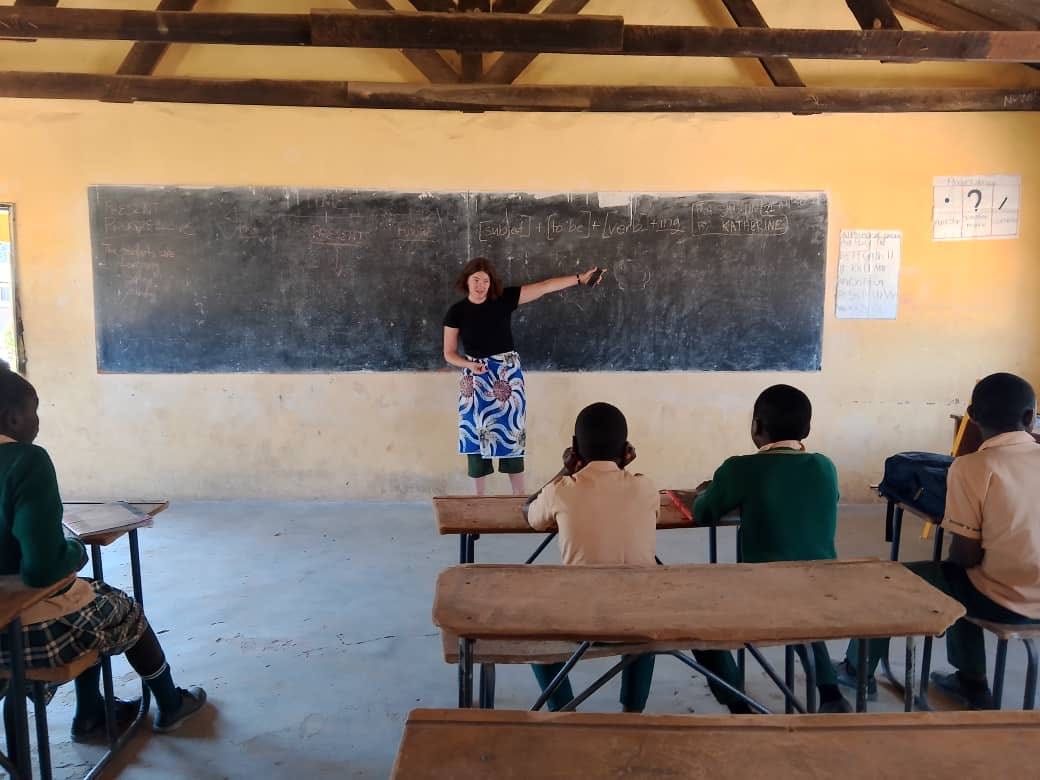
But I’m also soaking up the endless beautiful moments, like when the teaching volunteers visited a local primary school last week. We gave 20-minute “mini lessons” to young kids, who on their August holiday came into school just to hear us silly Americans stumble our way through a grammar lesson. Before we began our lessons, the students all gathered around the flagpole, where they sang us the Zambian national anthem in English and the local language, as well as their school song. From that first note, I had a tear in my eye. Sitting in a classroom all day for session after session, I’d lost sight on what I was actually here to do: teach kids. Hearing their song and seeing the joy on their faces will carry me through the lows.
That, and those Zambian sunsets (sans barbed wire, hopefully).
Get in touch via email, katherinevswartz@gmail.com or on WhatsApp.
Favorite Zambian word of the week: “Motola inkani” in Nyanja (the other main language) is for journalist. It literally means “someone who picks up news.”
It is a joy to read your well-crafted and beautifully written post, Katherine! I pray for health. safety, adequate rest, and strong tires 😜
Thank you, Katherine! Praying for you and your service to these dear people!